

Updated October 2026: aligned the article with the 2026 ACC/AHA dyslipidemia guideline (who should get a CAC scan, what CAC=0 means, score-based LDL goals), corrected claims about cholesterol and statins that current evidence does not support, updated costs and coverage, and replaced broken links.
What is the CAC test and why should clinicians care?
If your clients follow a low-carb or ketogenic diet, there's a good chance some of them have seen their cholesterol go up. Not just HDL, but also LDL. For some, often lean and metabolically healthy people, LDL rises dramatically, a pattern researchers have described as the "lean mass hyper-responder" phenotype, whose clinical significance is still being debated (Eur J Prev Cardiol, 2026). Clients on other diets, whether Paleo, vegetarian, low fat or no special plan at all, may also have high cholesterol and be weighing whether to start medication.
In these situations, a lipid panel on its own leaves an important question unanswered: does this person already have atherosclerosis? Some critics have argued that cholesterol is a poor surrogate end point (DuBroff, 2017), but the weight of genetic, epidemiologic and clinical trial evidence shows that LDL and other apoB-containing lipoproteins cause atherosclerotic cardiovascular disease (ASCVD) (European Atherosclerosis Society consensus, 2017).
What a lipid panel cannot tell you is how much plaque has already built up. It's possible to have modest cholesterol and significant coronary plaque, or high cholesterol with no detectable calcified plaque.
If you want to personalize the conversation with a client who has high cholesterol, rather than relying on cholesterol alone, the coronary artery calcium test (CAC) is one of the best-supported tools available. Current US guidelines recommend it to refine risk when treatment decisions are uncertain. We'll explore it in detail in a bit. First, let's look a little closer at the limits of using cholesterol as the only indicator of heart health.
Cholesterol Is Only Part of the Picture
For starters, many people who have heart disease or a heart attack have "normal" cholesterol. Normal cholesterol is no guarantee against a heart attack, and a high LDL result does not show whether plaque is actually present. That is why guidelines combine lipids with age, blood pressure, diabetes, smoking and other factors in a risk estimate, and then add risk-enhancing factors and imaging where needed.
You may also see observational studies suggesting that higher LDL-C is not associated with, or is even inversely associated with, mortality in people over 60 (Ravnskov et al., 2016), and a "reverse epidemiology" in which slightly higher blood pressure, BMI and cholesterol appear protective in frail older adults. These findings are prone to confounding (for example, illness and frailty lower cholesterol) and do not override the causal evidence linking LDL to ASCVD (EAS, 2017). What they do show is that a single number rarely tells the whole story for an individual.
Cholesterol Tells You About Exposure, Not Plaque
 Cholesterol is a risk factor. It's a measurement, not an illness. High total cholesterol or LDL-C is a marker of exposure to atherogenic particles over time, but a blood test does not show how much atherosclerotic plaque has already built up in a person's coronary arteries.
Two people with the same LDL can have very different amounts of coronary plaque. That is where imaging helps. The 2026 ACC/AHA multisociety guideline on dyslipidemia uses the PREVENT risk equations to estimate risk and then recommends coronary artery calcium scoring to reclassify risk when the decision to start or intensify lipid-lowering therapy is uncertain (Blumenthal et al., JACC 2026).
Bottom line: statins and other LDL-lowering therapies reduce cardiovascular events, and decisions about them belong to the clinician and patient together. The CAC score gives that conversation something concrete: a direct look at whether calcified plaque is present.
Enter the CAC Test
Since people who have heart disease or heart attacks span the full range of cholesterol levels, using cholesterol alone to judge an individual's risk is a bit like gauging metabolic health from glucose while ignoring insulin.
With this in mind, more physicians are using the coronary artery calcium scan. Unlike serum cholesterol, which estimates exposure, the CAC scan directly measures calcified plaque that has already formed. Not just the risk of atherosclerosis, but evidence of the disease itself.
Research shows that people who qualify for statins on a risk score alone are a mixed group. In the Multi-Ethnic Study of Atherosclerosis (MESA), "significant ASCVD risk heterogeneity exists among those eligible for statins according to the new guidelines. The absence of CAC reclassifies approximately one-half of candidates as not eligible for statin therapy." In that study, 44% of statin-eligible participants had a CAC score of zero and a low observed 10-year event rate.
Other studies bear similar findings. A study of 31,375 Korean adults concluded that CAC scoring could help reclassify statin eligibility, and found that a CAC score above 100 was associated with higher mortality in every guideline group.
What about the other side of this? What about people with normal or even "low" cholesterol? Does that go hand-in-hand with low risk for a cardiovascular event?
Not always. People with normal cholesterol can have calcified plaque. In a meta-analysis of women classified as low risk by traditional risk factors: "Among women at low ASCVD risk, CAC was present in approximately one-third and was associated with an increased risk of ASCVD and modest improvement in prognostic accuracy compared with traditional risk factors." In other words, one-third of women assessed as low risk already had measurable coronary calcium.
What is Coronary Artery Calcium and Why Test It?
Unlike cholesterol, a CAC score gives direct evidence of arterial plaque. The reason to measure calcium specifically is that "Coronary artery calcification is part of the development of atherosclerosis; it occurs exclusively in atherosclerotic arteries and is absent in the normal vessel wall." In other words, whether cholesterol is low, high or somewhere in the middle, detectable coronary artery calcium means atherosclerosis is present.
The reason to measure the extent of plaque is that plaques can rupture and trigger a clot that blocks the artery and cuts off blood flow to the heart, which is one way heart attacks happen.
Why does calcium end up in arteries? Calcification is part of how atherosclerotic plaque develops and is often described as part of the body's healing response within the plaque. Ivor Cummins and Jeffry Gerber, MD, describe it this way in their book, Eat Rich, Live Long:
"The body's response to damaged coronary arteries is always the same, and that response is what the CAC scan directly observes and quantifies. Your body tries to repair itself by depositing calcium in the damaged areas of the arterial wall. As the damage continues, these repair processes quicken. They desperately attempt to shore up the arterial walls before a rupture occurs. This growing calcium becomes the telltale sign of imminent danger: the ultimate canary in the coal mine."
What is the CAC Test?
 The CAC test, also called a "heart scan," is a non-invasive, non-contrast, ECG-gated CT scan of the heart. The scan itself takes only seconds, and the whole visit is short. Fasting is not required, but patients may be asked to avoid caffeine and smoking beforehand, since a fast heart rate can reduce image quality.
Cost and coverage have changed less than many people expect. Screening CAC scans for people without symptoms are generally not covered by Medicare, Medicaid or most private insurance, and out-of-pocket prices typically run from about $50 to $400 (JAMA, 2025), with many centers charging around $100 to $150 (GoodRx). Texas has a state coverage mandate, and the American Heart Association has supported broader coverage (AHA policy statement).
Results are usually reported as an Agatston score, which combines the area and density of calcium deposits, along with a percentile for the patient's age, sex and race. A score of zero means no calcified plaque was detected. When calcium is present, risk rises with the score: in one summary of the evidence, 10-year event rates were about 1% to 6% for a score of 0 and about 13% to 26% for a score above 300 (JAMA, 2025).
How Current Guidelines Use the Score
The 2026 ACC/AHA dyslipidemia guideline gives CAC scoring a Class I recommendation for adults at intermediate and selected borderline risk when the treatment decision remains uncertain. It is not a recommendation for universal screening (ConsultantLive summary). Summaries of the guideline describe these key points:
- Who: generally men 40 and older and women 45 and older at borderline (PREVENT 3% to under 5%) or intermediate (5% to under 10%) 10-year risk, plus some lower-risk adults with risk enhancers such as a premature family history, elevated Lp(a) or chronic inflammatory disease (Valley Medical Center summary).
- Who usually does not need it: people with established ASCVD, LDL-C of 190 mg/dL or higher, familial hypercholesterolemia, high estimated risk, or diabetes in the 40 to 75 age range, because treatment is already indicated (Valley Medical Center summary).
- CAC = 0: statin therapy may be deferred, with a focus on lifestyle and reassessment in about 5 years. Up to 40% of intermediate-risk adults have a score of zero, which makes CAC a powerful tool for downgrading risk (DynaMed summary). Testing is generally not recommended for people who currently smoke or have diabetes, because treatment is recommended for them regardless of the score (JAMA, 2025).
- CAC above 0: generally favors starting lipid-lowering therapy. Summaries describe score-based LDL-C goals: below 100 mg/dL for a score of 1 to 99; a 50% or greater reduction and below 70 mg/dL for 100 to 299; below 55 mg/dL for 300 or higher; and management similar to established ASCVD above 1,000 (ConsultantLive summary).
- Incidental calcium: coronary calcium seen on a routine (non-gated) chest CT is clinically meaningful and should not be ignored. A non-gated scan that shows no calcium does not replace a dedicated CAC scan (ConsultantLive summary).
The key point for low-carb practices: some clients have high LDL but a CAC score of zero, while others with similar numbers already have plaque. A CAC scan helps separate the two, which can make conversations about diet changes and medication more productive. Lp(a) and apoB testing, which the 2026 guideline also emphasizes, add further context.
The exact meaning of different coronary calcium scores differs depending on the source cited, but here's a general guide from Axel Sigurdsson, MD:
Coronary calcium score 0: No identifiable plaque. Risk of coronary artery disease very low (<5%)
Coronary calcium score 1-10: Mild identifiable plaque. Risk of coronary artery disease low (<10%)
Coronary calcium score 11-100: Definite, at least mild atherosclerotic plaque. Mild or minimal coronary narrowings are likely.
Coronary calcium score 101-400: Definite, at least moderate atherosclerotic plaque. Mild coronary artery disease highly likely. Significant narrowings possible
Coronary calcium score > 400: Extensive atherosclerotic plaque. High likelihood of at least one significant coronary narrowing.
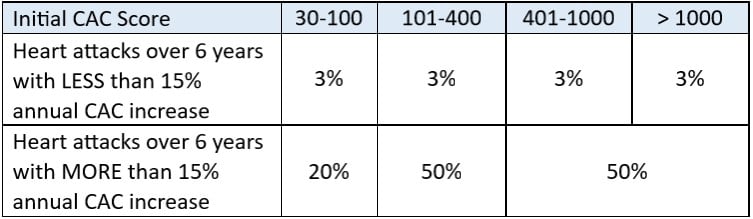
Here's another look at CAC scores, from Eat Rich, Live Long:


Progression matters too. In a 2004 study of 495 people who started statins, those who went on to have a heart attack showed much faster CAC progression (about 42% per year) than those who stayed event-free (about 17% per year), despite similar LDL levels (Raggi et al., 2004). Interpreting a rising score is not simple, however. Statins themselves promote calcification of existing plaque, which may be part of how they stabilize it (Puri et al., 2015), so current guidance does not recommend repeat CAC scans to monitor treatment response in people on statins (JAMA, 2025).
From Eat Rich, Live Long:
Track CAC Alongside Everything Else
A CAC score is most useful in context: next to apoB, Lp(a), the lipid panel, glucose and insulin markers, blood pressure and lifestyle data. Heads Up unifies labs, wearables, medical devices and EHR data in one longitudinal patient record, with lab PDFs extracted automatically, so a client's CAC result and every lipid panel before and after sit on one timeline. See also our longevity biomarker panel guide and our article on apoB, insulin resistance and other longevity metrics.
Not a Perfect Test
Although a low CAC score generally indicates a low risk for cardiovascular events, it's not a full guarantee. Unstable, non-calcified plaques vulnerable to rupture may be present in the absence of calcium deposition. A high CAC score increases the chance that vulnerable plaques are present, but it doesn't identify the specific places where a rupture or blockage might occur. Dr. Sigurdsson wrote:
"The presence and extent of coronary calcium are first and foremost markers of the extent of atherosclerosis within the coronary arteries. Nonetheless, it is important to understand that the coronary calcium score does not necessarily reflect the severity of narrowing (the degree of stenosis). Still, a patient with a high calcium score is more likely to have a significant narrowing of a coronary artery than a patient with a low calcium score. An individual without coronary artery calcification is very unlikely to have a severe narrowing of a coronary artery. Although cardiovascular events can occur in patients with very low calcium scores, the incidence is very low."
Take Action
If a client's CAC score is zero and they have no high-risk features, the guideline supports focusing on lifestyle and reassessing in about five years. If the score is elevated, use it to guide a more intensive plan, including LDL-lowering therapy where indicated and attention to blood pressure, glucose, smoking, sleep and activity.
Where does a low-carb diet fit? Carbohydrate restriction can improve triglycerides, HDL and other markers of atherogenic dyslipidemia, and is an effective option for type 2 diabetes and metabolic syndrome (Feinman and Volek, 2006) (Feinman and Volek, 2008). LDL response varies widely, though, and some people see large increases. A small, uncontrolled study of lean people on long-term ketogenic diets with very high LDL found that baseline plaque, not apoB or LDL, predicted plaque progression over one year (KETO-CTA, 2025), but this does not settle the question, and the long-term significance of diet-induced LDL elevations remains unresolved (Eur J Prev Cardiol, 2026). There is no good evidence that diet reverses established coronary calcium. For clients with high LDL on a low-carb diet, CAC, apoB and Lp(a) together give a far better basis for shared decisions than LDL alone.
See how Heads Up tracks CAC scores, lipids and wearable data for your clients: request a demo.
See how clinics use Heads Up
Unify labs, wearables and EHR data into one AI-assisted view. Book a walkthrough tailored to your practice.


3 comments
stretchmark treatment cream
I am really thankful to the holder of this web page who has shared this great post at at this time.
BB
I have been on a LCHF diet for 2.5 years and just had a CAC test done after seeing my LDL levels reach 295. (I believe I am what is called a hyper-responder to LCHF). The attending physician was horrified when I showed him the LDL-C score and promptly recommended I start taking a statin, which I have no intention of taking. I live in a country where ketogenic / LCHF is largely unknown in the medical community, so I can't get much in the way of advice. That being the case, I have been following the guidelines and advice on cholesterolcode.com.
Background: I am 52 years old, normal weight and exercise regularly (mostly yoga, cycling and running). My total cholesterol is 367, TRIG 88, HDL-C 66, HBA1C 4.9. My CAC test returned a score of 43. I was surprised that the score was that high. After 2.5 years on the diet (with only two cheat months when I was traveling in India), I thought it would be lower. This was my first CAC test, so it will act as the baseline. I'm going to get a ApoB and ApoA test tomorrow (it will take 12 days for the results) and will check out the ratio as I consider that to be much more indicative of a problem than just LDL. At this point, my plan is to continue on the same LCHF diet but supplement with 6000mg daily of Vitamin C and throw in some Lysine too (Pauling Therapy). I will then get another CAC test next year. Does that plan sound reasonable to you? Do you have any other recommendations? Don't worry I won't consider it "medical advice" — just a suggestion that I will talk over with my doctor . . . blah blah blah, lol Thanks in advance.
Andrew
I recently had the CAC examination completed after experiencing episodes of unexpected heart rate elevation elevation and shortness of breath. I'll confess to having poor dietary habits because though diabetic I believed I could still enjoy certain foods as long as I took my medication and monitored my bloodwork. So my lipids have appeared pretty stable over the last few years with total cholesterol typically between 90 to 130. A1C tends to fluctuate between 6 – 7 with a couple spikes around 8.
My Agatson score was over 3,000 (yes three zeros/4 digits). I am just at the beginning of this journey to get my coronary artery calcification under control but thought that it would be instructive to share this. There is extensive calcification without major symptoms or blood work indicative of an issue. The test itself is fairly affordable so I urge others to get it done.
Comments are closed.